16. PASS PLAY COVERAGE
16.1 - Terminology
-
On each side of the offensive formation, players in receiver positions
outside the tackles are identified by their position.
The widest receiver (the one closest to the
sideline)
is #1, the next widest is #2, and so on, for however many receivers are
on that side of the formation.
When receivers are
stacked
(lined up one behind another)
or
bunched
(lined up close together)
on one side of the formation, the one closest to the line of scrimmage
is #1 and the one behind them is #2, etc.
-
A forward pass play consists of three
phases:
-
Phase A is immediately after the snap when receivers are making their
initial movement.
-
Phase B is while players are running their pass routes or otherwise
trying to establish their position on the field to receive a pass.
-
Phase C is while the ball is in the air,
and until it is complete or incomplete.
-
In determining keys, the following definitions are needed:
-
Strength of the formation - determined by the number of
receivers on a particular side of the offensive formation.
The strong side is the side with the most receivers.
It has nothing to do with the number of linemen on each side of the
snapper
but rather the number of receivers positioned outside the tackles.
[IN xx1/xx3 FORMATION (CREW OF 5/6C/7/8)]
If there is no strong side (balanced formation), the Line Judge's side
is deemed to be the strong side.
-
Tight end / split end
- the end player
on the line of scrimmage. A
tight end
is usually lined up no more than 4 yards from the nearest offensive
lineman.
If they
are
lined up wider, then they
are
a
split end.
-
Slot back / flanker back
- a back lined up outside the nearest
interior lineman or tight end.
A
slot back
is usually lined up no more than 4 yards from the nearest offensive
lineman.
If they
are
lined up wider then they
are
a
flanker back.
-
Back in the backfield - a player in the backfield between the tackles
at the snap.
-
Press coverage - when a defender lines up in a position where they
are
close enough that they can touch the receiver as the receiver leaves the
line of scrimmage.
-
Trips - three receivers on one side of the offensive formation outside
the tackles.
-
Quads - four receivers on one side of the offensive formation outside
the tackles.
-
It does not matter in determining keys whether a player is:
-
on or off the line of scrimmage; or
-
wearing a number between 50-79
or not.
-
If the formation is illegal (e.g. too many players in the backfield, more
than one player in motion at the snap),
the crew should failsafe to keys based on the position of players at
the snap.
-
If the formation is new or unusual then verbally or visually confirm
keys with other officials.
16.2 - General principles for pass play coverage
-
During Phase A, be in man coverage, watching receivers who are covered
by defenders in press coverage.
-
During this phase, there is likely to be physical contact between the
defender and the receiver, and the responsible official must be able to
rule on whether that is legal or not.
-
The most common fouls in this situation are defensive holding and
offensive pass interference.
-
Receivers who are
not
covered do not normally need to be observed, since the likelihood of a
foul being committed by or against them is low.
However, that may change due to the movement of the players.
-
If your key receiver(s) is not threatened by a defender, switch
immediately to Phase B.
-
During Phase B, be in zone coverage, observing receivers and defenders
in your zone.
-
Only observe receivers who are close to defenders, since it is those
players who are threatened by being fouled.
Receivers and defenders who are not close to opponents should not be
observed because there is little risk of a foul.
The exception to this is any receiver who approaches a boundary line.
You
need to know if they go out of bounds voluntarily and thereby lose their
eligibility to touch a pass.
-
If there are no players in your zone who are close to an opponent,
expand your zone until it includes close opponents who may not be being
observed by another official.
-
In the early stages of a play, as receivers cross the line of scrimmage,
the zones for which the deep officials are responsible will be very
close to the line of scrimmage.
As receivers move downfield, those deep zones will expand and shallow
zones will form behind them.
-
If there is more than one receiver in your zone who is close to an
opponent, normally observe the one nearer you, since it is more likely
that another official will be able to observe the other(s).
This calls for good teamwork between the Back Judge, the wing officials
and the deep wing officials.
-
The most common fouls during Phase B are defensive holding, offensive
pass interference and illegal use of hands (Rule 9-3-4-e).
-
In addition, look out for receivers going out of bounds (voluntarily
or forced) at the sideline or end line.
-
During Phase C, be in destination coverage, observing receivers and
defenders in the vicinity of where the pass will arrive.
When the destination of the pass is obviously out of bounds, observe
players nearest to that point.
-
Only observe receivers who are close to defenders, since it is those
players who are threatened by being fouled.
Receivers and defenders who are not close to opponents should not be
observed because there is little risk of a foul.
-
The most common fouls in this situation are defensive pass interference
and offensive pass interference.
-
During this phase you also have a responsibility to observe fouls
away from the destination zone such as unnecessary roughness and
unsportsmanlike conduct.
-
The following sections cover the responsibilities of the pass-covering
officials on each size of crew.
The responsibilities listed here do not normally apply to the Referee,
Umpire or Centre Judge, except that, in Phase C, the Umpire should also
always observe action in the vicinity of where the pass will arrive.
16.3 - Crew of 4
-
During Phase A, the wing officials key all eligible receivers (#1-#4)
on their side of the field.
Where there is more than one eligible receiver, the primary key is
any receiver in press coverage.
-
During Phase B, each wing official is responsible for the zone covering
their half of the field.
-
During Phase C, each official is responsible for observing action in
the vicinity of where the pass will arrive.
16.4 - Crew of 5/6C
-
During Phase A:
-
The Back Judge always keys on the inside eligible receiver(s) outside
the tackles (normally #2, but #3 in trips or #4 in quads) on the strong
side of the formation.
This will normally be the tight end or slot back.
-
The wing officials always key on the widest player of the offensive
formation on their side of the field (#1).
This will normally be either a split end or a flanker back unless the
Back Judge is keying on them.
-
If the formation is balanced and there is only one eligible receiver to
each side, the Back Judge has no key.
If there are two receivers to each side, the Back Judge keys on
the inside player (#2)
on the Line Judge's side, and the
Down Judge
keys on
the two on their side (#1 and #2), giving priority to one who is in press
coverage.
-
If there are three eligible receivers on the strong side, who keys on
the #2 receiver will depend on whether #2 is closer to #1 or #3.
If #2 is closer to #1, the wing official will key on #1 and #2.
If #2 is closer to #3, the Back Judge will key on #3 and #2.
-
If there are quads, who keys on the #2 and #3 receivers will depend on
where they are relative to #1 and #4.
If either or both is close to #1, the wing official will key on #1
and #2 (and #3 if all are close).
If either or both is close to #4, the Back Judge will key on #4 and
#3 (and #2 if all are close).
-
A player
who goes in motion will be the responsibility of the
Back Judge unless they
are
the widest player at the snap.
-
During Phase B:
-
The Back Judge will have the zone containing the deepest receiver,
particularly if the receiver is in or moving towards the middle of
the field.
-
The wing officials will have the zone containing shallow receivers in
their half of the field, plus any deep receiver who is not covered by
the Back Judge, and any receiver who is moving towards, or threatens to
go out of bounds on, their side.
-
During Phase C, each official is responsible for observing action in
the vicinity of where the pass will arrive.
16.5 - Crew of 6D
-
During Phase A:
-
The deep wing
officials always key on the widest player of the offensive formation on
their side of the field (#1).
-
The wing officials always key on the most inside receiver outside the
tackles (#2-#4) (often the tight end or slot back)
on their side of the field.
If there is only one receiver, the wing official has no key.
-
If there are trips, who keys on the #2 receiver will depend on whether
#2 is closer to #1 or #3.
If #2 is closer to #1, the deep wing official will key on #1 and #2.
If #2 is closer to #3, the wing official will key on #3 and #2.
-
If there are quads, who keys on the #2 and #3 receivers will depend on
where they are relative to #1 and #4.
If either or both is close to #1, they are keyed by the deep wing
official.
If either or both is close to #4, they are keyed by the wing official.
-
If there is motion, keys are determined by the position of the motion
man at the snap (not by their direction).
If they
are
the widest player (#1) then they will be the responsibility of the
deep wing
official on that side,
otherwise they
are
keyed by the wing official.
-
During Phase B:
-
Each deep wing official is responsible for the zone containing the
deepest receiver in their half of the field.
-
Each wing official is responsible for the zone covering all shallow
receivers in their half of the field.
-
During Phase C, each official is responsible for observing action in
the vicinity of where the pass will arrive.
16.6 - Crew of 7/8
-
During Phase A:
-
The Side Judge and Field Judge always key on the widest player of the
offensive formation on their side of the field (#1).
This includes the motion man if their motion makes them the widest
player at the snap.
-
If there is a back in motion, the Back Judge keys on them unless they
are
the widest player on their side of the formation at the snap.
-
If there are 2 receivers to the strong side, the Back Judge always keys
on #2.
If the formation is balanced, the Back Judge keys on #2 on the Line
Judge's side and the
Down Judge
keys on #2 on their side.
-
A wing official has no key if the deep wing officials and Back Judge
are keying on all players on their side of the formation.
-
If there are trips, the Back Judge keys on #3 and the wing official keys
on #2.
-
If there are quads, the Back Judge normally keys on #4 and #3 and the wing
official keys on #2.
However, if #3 is separate from #4 and nearer #2 the wing official keys
on #3 as well as #2.
-
During Phase B:
-
Each deep wing official is responsible for the zone containing the
deepest receiver in their third of the field.
-
The Back Judge is responsible for the zone containing the deepest receiver
in the middle of the field.
-
Each wing official is responsible for the zone containing shallow
receivers in their half of the field.
-
During Phase C, each official is responsible for observing action in
the vicinity of where the pass will arrive.
16.7 - Summary
The table shows which official keys on which receiver according to the
receiver's position on their side of the formation.
|
Formation |
Crew of 5/6C |
Crew of 6D |
Crew of 7/8
|
|
|
|
Wing |
BJ |
Wing |
Deep |
Wing |
Deep |
BJ
|
|
Balanced |
1 |
1 |
- |
- |
1 |
- |
1 |
-
|
|
|
1_2 |
12D |
2L |
2 |
1 |
- |
1 |
2
|
|
Normal |
1 |
1 |
- |
- |
1 |
- |
1 |
-
|
|
|
1_2 |
1 |
2 |
2 |
1 |
- |
1 |
2
|
|
Trips |
12_3 |
12 |
3 |
3 |
12 |
2 |
1 |
3
|
|
|
1_23 |
1 |
23 |
23 |
1 |
2 |
1 |
3
|
|
Quads |
1_234 |
1 |
234 |
234 |
1 |
2 |
1 |
34
|
|
|
12_34 |
12 |
34 |
34 |
12 |
2 |
1 |
34
|
|
|
123_4 |
123 |
4 |
4 |
123 |
23 |
1 |
4
|
|
|
1_23_4 |
12 |
34 |
34 |
12 |
23 |
1 |
4
|
|
Motion |
M_2 |
M |
|
|
M |
|
M |
|
|
|
1_M |
|
M |
M |
|
|
|
M
|
16.8 - Crew of 5 examples
This section also covers crews of 6C with the addition of the Centre
Judge in the offensive backfield opposite the Referee.
1mFigure A: Pro set
1m
1m
1m
1m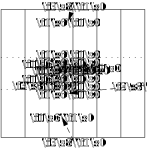 1m
1m
1m
1mL's side is the strong side.
1m
1m
1m
1mFigure B: Slot formation
1m
1m
1m
1m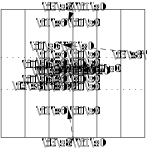 1m
1m
1m
1m
1mD's
1m
1mside is the strong side.
1mB keys on the slot back on that side.
1m
1mD
1m
1mkeys on the split end.
1mL keys on the split end on the other side.
1m
1m
1m
1mFigure C: Wishbone formation
1m
1m
1m
1m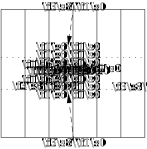 1m
1m
1m
1mBalanced formation with one receiver each side.
1mB keys on first back out of the backfield.
1m
1m
1m
1mFigure D: Single-wing formation
1m
1m
1m
1m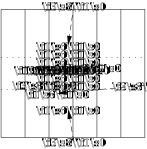 1m
1m
1m
1mL's side is the strong side.
1mB keys on the slot back.
1mL keys on the
1m
1msplit end.
1m
1m
1mD
1m
1mkeys on the tight end to their side.
1m
1m
1m
1mFigure E: Spread formation
1m
1m
1m
1m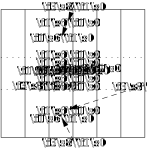 1m
1m
1m
1mFormation is balanced with two receivers each side; strength declared
1mto L's side.
1mB keys on second player
1min on that side.
1mL keys on the flanker on that side.
1m
1mD
1m
1mmust key on both receivers on their side.
1m
1m
1m
1mFigure F: Double-wing formation
1m
1m
1m
1m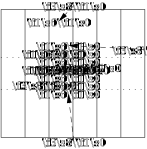 1m
1m
1m
1m
1mD's
1m
1mside is the strong side.
1mB keys on the tight end on that side.
1mL keys on the other tight end.
1m
1mD
1m
1mkeys on the flanker back on their side.
1m
1m
1m
1mFigure G: Triple receivers on one side (1)
1m
1m
1m
1m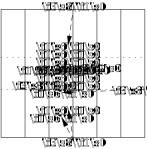 1m
1m
1m
1mL's side is the strong side.
1mB keys on the slot back.
1mL keys both
1m
1mthe split end and the flanker back.
1mD
1m
1mkeys on the tight end who is positioned on the weak side.
1m
1m
1m
1mFigure H: Triple receivers on one side (2)
1m
1m
1m
1m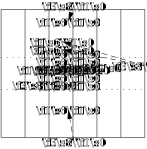 1m
1m
1m
1m
1mD's
1m
1mside is the strong side.
1mB keys on both slot backs.
1m
1mD
1m
1mkeys split end on that side.
1mL keys on split end on other side.
1m
1m
1m
1mFigure I: Motion which changes strength
1m
1m
1m
1m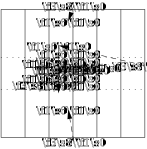 1m
1m
1m
1mStrength is initially to
1m
1mD's
1m
1mside.
1m
1mD
1m
1mkeys on split end on their side.
1mL keys on split end on other side.
1mB keys on the slot back and stays with them as they
1mchange
1msides.
1m
1m
1m
1mFigure J: Motion which does not change strength
1m
1m
1m
1m 1m
1m
1m
1mStrength is initially to
1m
1mD's
1m
1mside.
1m
1mD
1m
1mkeys on split end on
1m
1mD's
1m
1mside.
1mL keys on split end on weak side.
1mB keys on slot back, and also the motion man if they
1mare
1mnear the slot
1mback at the snap.
1mIf the motion man goes to the L's side, the strength changes, B has only
1mthe motion man, and
1m
1mD
1m
1mneeds to key on both players on their side.
1m
1m
1m
1m
1m16.9 - Crew of 6D examples
1m
1m
1m
1m
1mFigure A: Pro set
1m
1m
1m
1m
1m
1m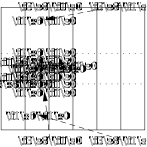 1m
1m
1m
1mL's side is the strong side.
1mF keys on the flanker.
1mS keys on the split end.
1mL keys on the tight end.
1m
1m
1m
1mFigure B: Spread receivers
1m
1m
1m
1m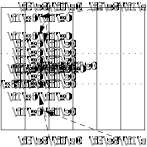 1m
1m
1m
1m
1mD's
1m
1mside is the strong side.
1mF keys on the
1m
1msplit end
1m
1mon the weak side.
1mL keys on the second receiver on that side.
1mS keys on the flanker back.
1m
1mD
1m
1mkeys on the end on their side and the remaining receiver.
1m
1m
1m
1mFigure C: Double tight end and balanced backfield
1m
1m
1m
1m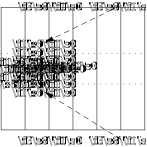 1m
1m
1m
1mBalanced formation.
1mS & F key on the tight ends.
1m
1m
1m
1mFigure D: Motion
1m
1m
1m
1m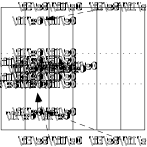 1m
1m
1m
1mWhen the motion man ceases to be the widest player in the formation,
1mthey
1mbecome
1m
1mL's responsibility and F
1m
1mkeys on the split end.
1m
1m
1m
1m16.10 - Crew of 7 examples
1m
1m
1m
1m
1m
1mThis section also covers crews of 8 with the addition of the Centre
1mJudge in the offensive backfield opposite the Referee.
1m
1m
1m
1mFigure A: Pro set
1m
1m
1m
1m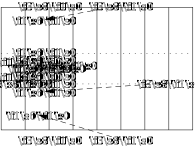 1m
1m
1m
1mL's side is the strong side.
1mF keys on the flanker.
1mS keys on the split end.
1mB keys on the tight end.
1m
1m
1m
1mFigure B: Spread receivers
1m
1m
1m
1m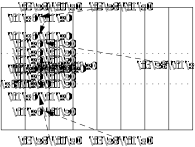 1m
1m
1m
1m
1mD's
1m
1mside is the strong side.
1mF keys on the
1m
1msplit end
1m
1mon the weak side.
1mL keys on the second receiver on that side.
1mS keys on the flanker back.
1m
1mD
1m
1mkeys on the second receiver on their side.
1mB keys on the most inside receiver on the strong side.
1m
1m
1m
1mFigure C: Double tight end and balanced backfield
1m
1m
1m
1m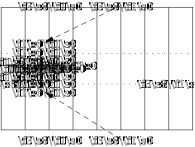 1m
1m
1m
1mBalanced formation with one receiver outside the tackles on each side.
1mS & F key on the tight ends.
1m
1m
1m
1mFigure D: Motion
1m
1m
1m
1m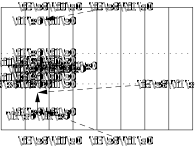 1m
1m
1m
1mWhen the flanker goes in motion
1m
1mB
1m
1mand F exchange keys.
1m
Next chapter (timeout)
Back to index
Editor: Jim Briggs, Editor, IAFOA Manual of Football Officiating
jim.briggs.football@gmail.com
Generated: 27/2/2026, 1549